
COAs
Certificate of Analysis


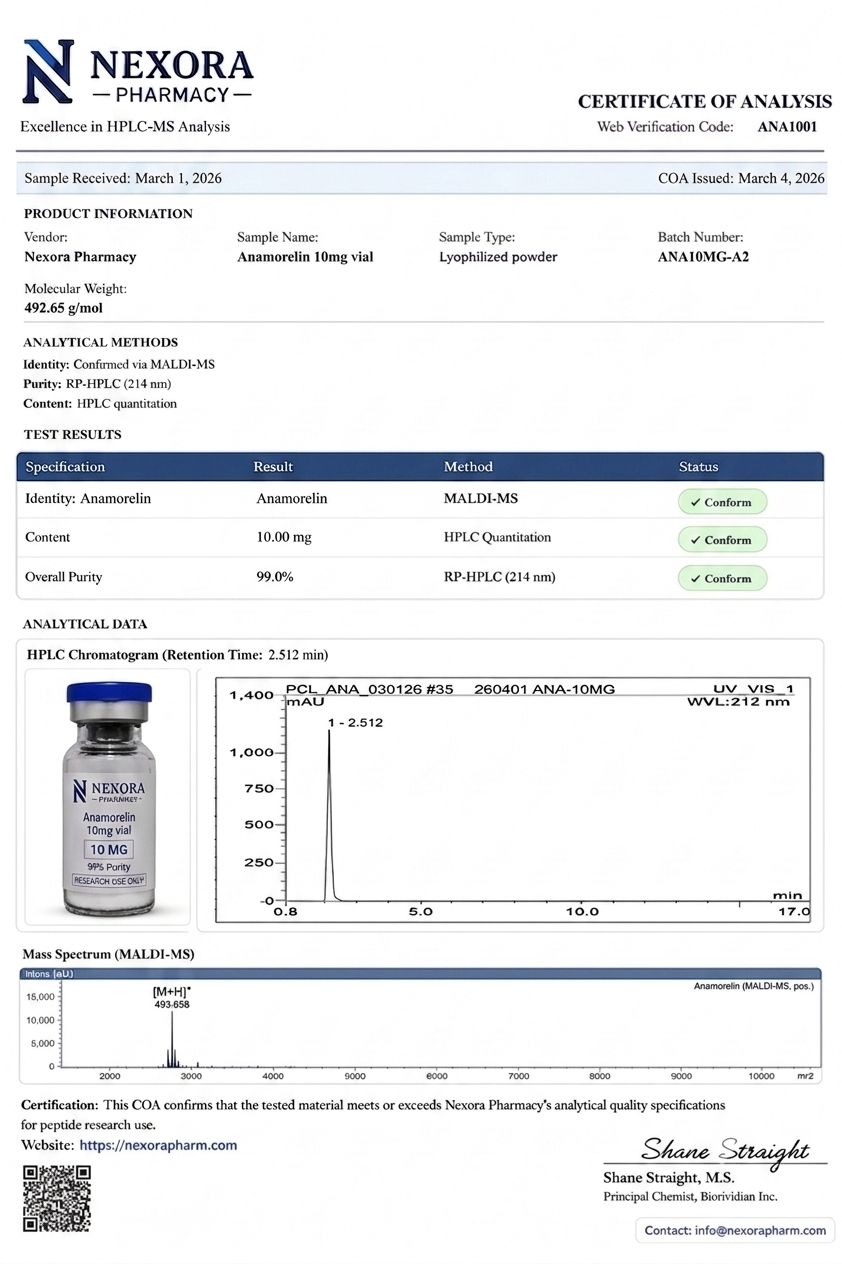
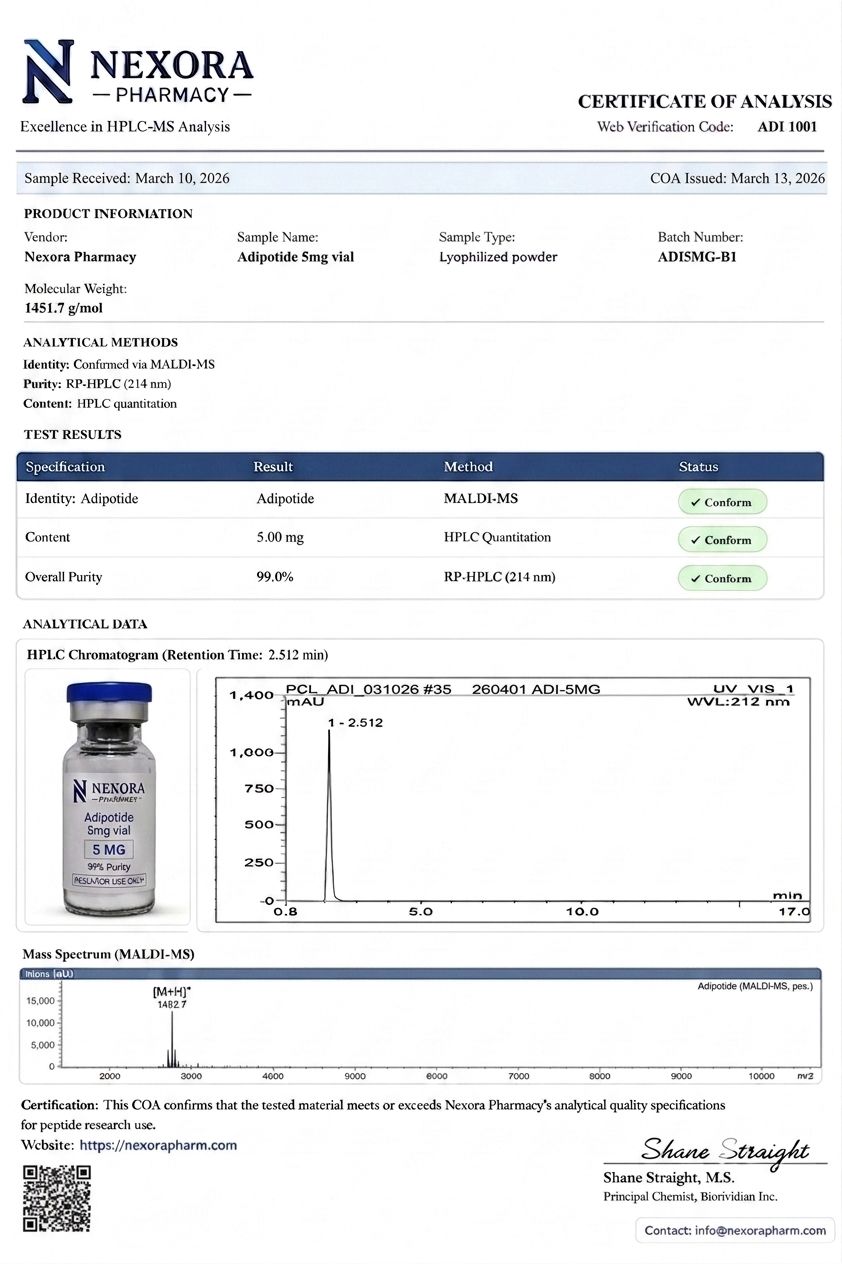

For an online pharmacy, a Certificate of Analysis (COA) is the ultimate document of truth. It is the formal laboratory report that proves a batch of peptides is exactly what it claims to be, at the strength it claims to be, and completely free of toxic contaminants. Because the FDA heavily scrutinizes the compounding and distribution of peptides, your pharmacy must know how to audit these documents from your raw material suppliers (API manufacturers). Selling a batch with a fraudulent or subpar COA can result in severe legal penalties and a total loss of business credibility.A gold-standard, compliant peptide COA requires three core pillars of testing:
1. The Three Core Pillars of a Peptide COA
Pillar 1: Identity Confirmation via Mass Spectrometry (MS)What it does:
It answers the question: Is this actually the correct molecule? A sample can be 99% pure, but it could be 99% pure of the entirely wrong compound. What to look for: The COA must list the Theoretical Molecular Weight (what the molecule should weigh based on its amino acid sequence) and the Observed Molecular Weight (what the lab equipment actually measured). The Standard: On modern LC-MS/MS equipment, the observed weight should match the theoretical weight with extreme precision—historically within a tight margin, but modern standards expect accuracy within parts per million (ppm). If the numbers deviate significantly, the peptide has the wrong sequence or is truncated (missing amino acids).
Pillar 2: Purity Analysis via High-Performance Liquid Chromatography (HPLC)What it does:
It answers the question: How much of the powder in the vial is the active peptide versus manufacturing byproducts?What to look for: The COA must include the actual HPLC Chromatogram—a visual graph showing data peaks. The main peak represents your target peptide, while tiny secondary peaks represent impurities (like deleted sequences, dimers, or oxidation products). Purity is calculated by dividing the area under the main peak by the total area of all peaks combined. The Standard: For medical and premium research applications, the industry standard is greater than or equal to 98.0% or 99.0% purity. The FDA’s guidance for synthetic peptides sets rigid impurity thresholds: single unknown impurities should generally not exceed 0.10%, and total impurities should be strictly capped.
Pillar 3: Safety & Contaminant
TestingBecause peptides are almost exclusively administered via injection, purity alone isn’t enough. A clean HPLC graph does not catch biological toxins.Endotoxin Testing (LAL Assay): Measures bacterial byproducts. Must be reported in Endotoxin Units (EU/mg). For safety, it must show a “Pass” or fall well below standard safety thresholds (typically less than 5 EU/mg depending on the compound). Bioburden / Sterility: Confirms the absence of live bacteria, yeast, and mold. Residual Solvents & Trifluoroacetic Acid (TFA): TFA is heavily used during peptide synthesis to split the chains. The final purification process must wash this out. A compliant COA should show residual TFA levels at safe, minimal levels (typically less than 1%).
2. Red Flags: How to Spot a "Fake" or Invalid COA
As a pharmacy owner, you will be targeted by overseas raw powder wholesalers offering incredibly cheap prices backed by “perfect” COAs. You must train your compliance team to spot these common red flags:
No Visible Chromatogram Graph: If a supplier sends a PDF that simply states “Purity: 99.2%” in plain text but does not include the actual raw HPLC graph with its baseline and elution peaks, reject it immediately. Anyone can type a number on a page.
Perfect Round Numbers: Real analytical chemistry rarely yields perfectly rounded data. If you see a COA that claims exactly 99.00% or 95.00%, it is likely a fabricated template. Look for precise, unedited decimals (e.g., 98.73%).
Missing or Mismatched Batch/Lot Numbers: The unique Batch or Lot Number on the COA must perfectly match the tracking number printed on the physical vials or bulk powder bags you receive. If there is no lot number, the document is legally useless for traceability.
“Representative Sample” Disclaimers: Some manufacturers test one premium batch, and then reuse that exact same COA PDF for every single batch they produce for the next two years. A valid COA must have a testing date that closely aligns with the manufacturing date of your specific lot.
🛡️ Best Practice for Nexora Pharm
Never rely solely on an “in-house” COA provided by the factory that sold you the material. To legally protect your online pharmacy operation, implement a blind third-party testing protocol.
When a bulk shipment arrives, route random sample vials to an independent, ISO 17025 accredited analytical laboratory. Have them run an independent HPLC/MS and Endotoxin panel. Matching your independent lab’s results against your supplier’s COA is the only bulletproof way to guarantee patient safety and satisfy FDA compounding audits.
Want to review how to calculate net peptide content vs. gross vial weight on a lab report?
For a pharmacy setting up its compounding and dosing protocols, confusing Net Peptide Content with Gross Weight is one of the most critical errors a team can make. It directly leads to under-dosing patients.
When a lab report or Certificate of Analysis (COA) states that a vial contains “5 mg” of a peptide, that number can mean two completely different things depending on how the manufacturer measures it.
Here is the exact breakdown of the difference and how it fundamentally alters your pharmacy’s dosing calculations.
⚖️ The Core Difference
Gross Weight (Total Powder) = Net Peptide + Counter-ions + Residual Water
Gross Weight (Total Vial Weight)
Gross weight refers to the entire mass of the lyophilized (freeze-dried) powder inside the vial. Peptides cannot exist as pure, isolated molecules in a dry state; they require stabilizing agents and counter-ions to remain chemically stable. Therefore, gross weight includes:
The actual target peptide molecules.
Counter-ions / Salts: Usually acetate or trifluoroacetate (TFA), which are chemically bonded to the peptide to stabilize its pH.
Residual Moisture: Trace amounts of water left over from the freeze-drying process.
Bulking Agents (if added): Excipients like mannitol or lactose used to create a visible, solid “cake” in the vial.
2. Net Peptide Content (Active Ingredient)
Net peptide content refers exclusively to the actual weight of the pure peptide chains, completely discounting the weight of the water, salts, or bulking agents. It tells you exactly how much active biological medication is present to interact with the patient’s cellular receptors.
The Industry Standard: In professional pharmaceutical compounding, the Net Peptide Content is the only number that matters for therapy. The rest of the mass is inert “dead weight” from a therapeutic standpoint.
🔍 How It Appears on a Certificate of Analysis (COA)
When auditing a COA from a wholesale API supplier, look for the following specific line items:
Purity (HPLC): This tells you what percentage of the peptides are correct and undamaged (e.g., 98%). It does not tell you how much of the powder is peptide.
Peptide Content (or Net Peptide Purity): This is the crucial percentage. In raw bulk peptides, this number typically ranges from 70% to 85%. This means that in a raw batch of powder, 15% to 30% of the weight is actually just salt and water.
🧮 The Dosing Trap: Why It Matters for Your Pharmacy
If your online pharmacy’s automated dosage calculator or your compounding pharmacists assume that 100% of the powder weight is active medication, your patients will be systematically under-dosed.Example Scenario:You are dispensing a vial of a therapeutic peptide labeled as 5 mg.The COA states the Peptide Content is 80%.The COA states the Chemical Purity is 98%.Calculation A: The Wrong Way (Using Gross Weight)If you assume Gross Weight = Active Medication:You tell the patient or doctor there are 5 mg of active peptide in the vial.You calculate your reconstitution volume (e.g., adding 2 mL of bacteriostatic water) based on a 5 mg yield.Calculation B: The Correct Way (Using Net Peptide Content)To find the actual amount of active therapeutic material available, you must multiply the gross weight by the net peptide content percentage:$$\text{Actual Active Peptide} = \text{Gross Weight} \times \text{Peptide Content \%}$$$$5\text{ mg (Gross Powder)} \times 0.80\text{ (Peptide Content)} = 4.0\text{ mg of Active Peptide}$$The Result: The vial actually only contains 4.0 mg of the medicine, not 5 mg. If you dosed based on 5 mg, the patient is receiving 20% less medication than their doctor prescribed. To fix this, the manufacturer must overfill the vial to a gross weight of 6.25 mg of powder so that the net peptide yield hits a perfect 5.0 mg.
🛡️ Best Practices for Nexora Pharm's Inventory & Labeling
To ensure absolute safety and regulatory compliance in the market, implement these operational rules:
Demand “Net Weight” Formulation: When negotiating with your API manufacturers or compounding partners, explicitly mandate that all finished retail vials must be filled based on Net Peptide Weight. If a vial is labeled “5 mg,” it must contain 5 mg of active peptide, meaning the gross powder weight inside will be higher (e.g., 6.1 mg).
Audit the “Mass Balance”: Ensure your quality control team cross-references the moisture content, amino acid analysis, and counter-ion content on the COA. They should all add up to 100% of the gross weight.
Standardize Reconstitution Guides: Provide clear instructions to your telehealth doctors and patients. If your pharmacy sells a customized compound where the net weight requires specific math, your automated platform must handle that logic internally so the end-user simply gets a flawless, accurate “mg per mL” conversion.